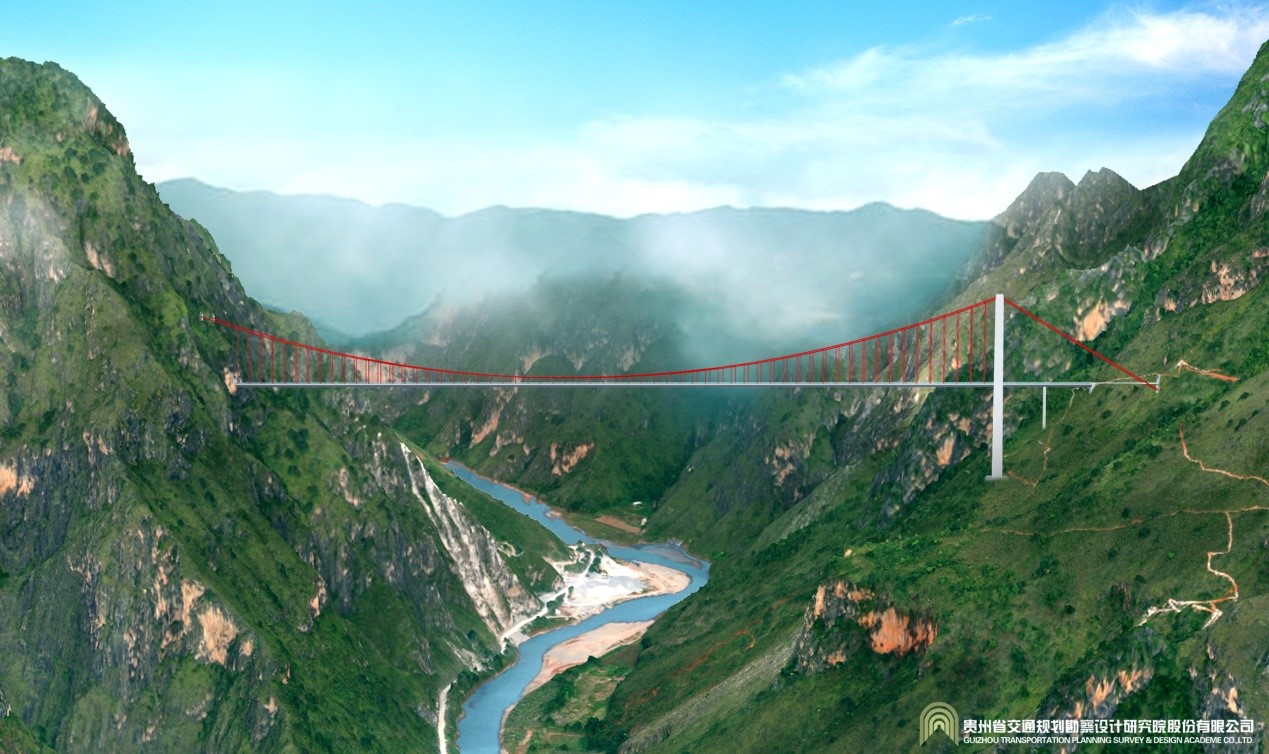
At 11:06 a.m. on November 10, as the final batch of concrete was slowly poured into the formwork for the 28th segment of the left tower leg of the main tower, the tower columns of the Yuchu Expressway Lüzhijiang Super Bridge—the world’s largest single-tower suspension bridge designed by Guizhou Provincial Transportation Planning, Survey and Design Research Institute Co., Ltd.—were successfully topped out.
The Lüzhujiang Grand Bridge is a key control project on the Yuxi-Chuxiong Expressway in Yunnan Province. Located at the border between Yimen County and Shuangbai County, it spans the Lüzhujiang River. The bridge has a total length of 798 meters, with a four-lane, two-way roadway, and a design speed of 100 kilometers per hour.
The bridge spans a typical, deeply incised “V”-shaped canyon. The terrain features continuous, rolling mountain ranges with steep slopes; the elevation difference between the bridge deck and the river surface is approximately 320 meters. On the Yuxi side, the average slope is about 40°, making it a steep slope terrain; on the Chuxiong side, the average slope is around 75°, approaching sheer cliffs. Vegetation is poorly developed on both banks, and bedrock is exposed. The bedrock consists primarily of dolomitic limestone and slate.
Given the highly complex topographical and geological conditions, the bridge is configured as a single-tower, single-span suspension bridge with a steel box girder. The span lengths of the main cables are 140 meters for the side spans and 780 meters for the central span. Due to terrain constraints, the section measuring 71.4 meters near the Chuxiong bank is designated as a cable-free zone. The central span has a vertical sag-to-span ratio of 1/11. The steel box girder has a total length of 711 meters. The main towers adopt a portal-frame structure, each standing 156 meters high. Both banks are equipped with tunnel-type anchorages.
On the Chuxiong side, it was not possible to erect a main tower; therefore, a single-sidewall suspension bridge structure was adopted. The main cables pass through cable tunnels drilled into the steep cliffs and are supported by roller-type composite cable saddles. From these saddles, the main cable strands are dispersed and anchored within tunnel-type anchorages embedded in the mountain. The anchorages are located above the connecting tunnels, with a minimum clearance of 32 meters from the tunnels. At the Chuxiong side, the stiffening girders are directly connected to the tunnel portals. This design eliminates both the main tower and the side spans of the main cables on the Chuxiong side, significantly reducing the volume of excavation and protection work required for the Chuxiong bank slope. Additionally, a 200-meter-long construction cross-tunnel has been employed to facilitate tunnel anchoring. The cable tunnels can be excavated from the inside out, achieving a “zero-grade slope” condition. This approach delivers substantial economic benefits and ensures that the structural design blends seamlessly with the surrounding environment, creating a visually stunning landscape.
The Yuchu Expressway is a crucial component of the Guangkun Expressway and an important part of Yunnan Province’s expressway network. The total length of the route is 190.597 kilometers. Upon completion, this project will become the most convenient highway link connecting Yuxi and Chuxiong. It will also serve as a vital connecting route between the Kunmo Expressway (G8511) and the Hangrui Expressway (G56), holding profound significance for promoting the economic and social development of the regions along its route.