


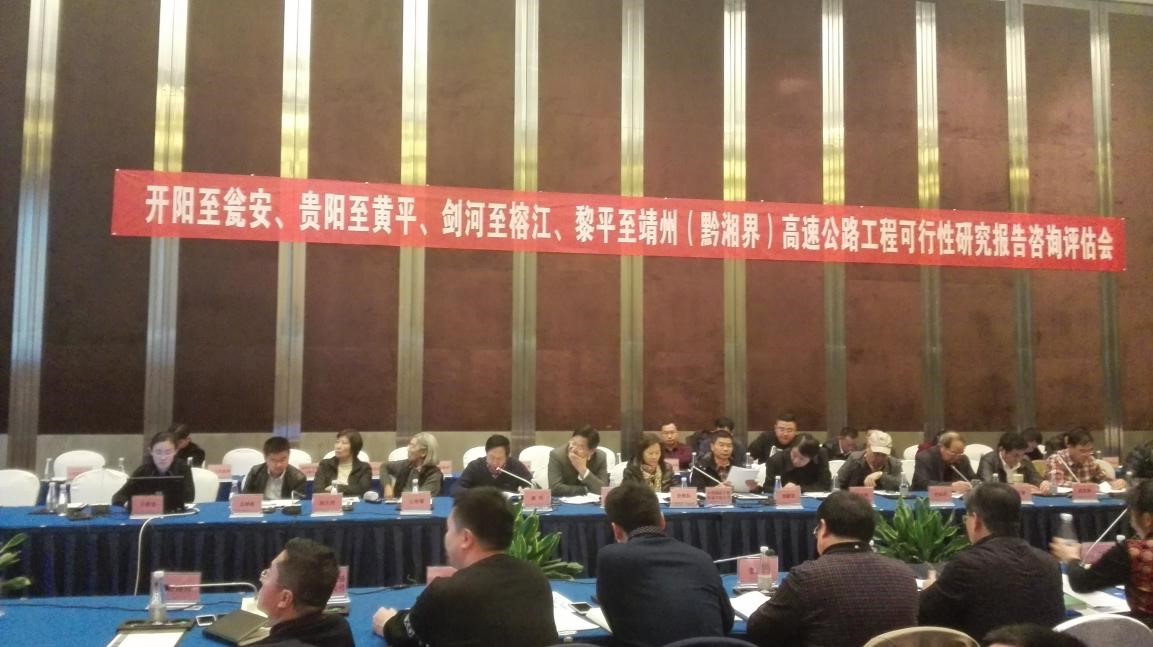
The consultation and evaluation meeting for the feasibility study report on the expressway projects—“Kaiyang to Weng’an, Guiyang to Huangping, Jianhe to Rongjiang, and Liping to Jingzhou (Guizhou-Hunan Border)”—undertaken by the joint-stock company was held.
Release time:
2017-04-01 08:17
Source:
From February 27 to March 4, 2017, the industry consultation and evaluation meeting for the feasibility study of the highway projects—“Kaiyang to Weng’an, Guiyang to Huangping, Jianhe to Rongjiang, and Liping to Jingzhou (on the Guizhou-Hunan border)” —was held in Guiyang. Relevant departments including the Provincial Department of Transport, the Provincial Development and Reform Commission, the Provincial Department of Environmental Protection, and the Provincial Department of Forestry, as well as experts and representatives from the municipal and prefectural authorities of Guiyang City, Qiannan Prefecture, and Qiandongnan Prefecture, and from China International Engineering Consulting Corporation, attended the meeting and conducted on-site inspections.
The Kaiyang to Wengan Expressway starts approximately 5 kilometers west of the Wengan Interchange on the Gui-Weng Expressway (Baixi), passes through Zhongping, Huali, and Fengsan, and ends at Sanhechang, where it connects to the Zun-Gui Duplicate Line. The key control points along the route are Baixi in Wengan, Huali, and Sanhechang in Kaiyang. The recommended route length is about 44.24 kilometers. This project is an important component of the “Horizontal 3” line—the Jiangkou to Duge Expressway—within the “678” Highway Network Plan for Guizhou Province (2009–2030). It has also been included as one of the “major newly initiated provincial expressway projects” in the “13th Five-Year Plan for Comprehensive Transportation Development of Guizhou Province” (Guizhou Provincial Government Document No. 9 [2017]).
The Guiyang-Huangping Expressway in Guizhou Province starts at Fengjiazhuang, Yongle Township, Nanming District, Guiyang City, and intersects with the Yu-Kai Expressway north of Huangping County Town. It also connects seamlessly to the Shibing Branch Line. The major control points along the route are Fengjiazhuang (starting point), Ximahu River, Longchang, and Huangping. The total length of the route is 119.333 kilometers. This project is an important segment of the Guiyang-Dalong Expressway, one of the two “capacity-enhancing corridors” added in the revised version of the “Guizhou Provincial Expressway Network Plan (2009-2030) (Reinforcement Plan).” It has been included as a key implementation project in the “13th Five-Year Plan for Integrated Transportation Development of Guizhou Province.”
The Jianhe–Rongjiang Expressway starts at Zaitou, at the junction of Jianhe County and Sansui County, where it connects seamlessly with the Sinan–Jianhe Expressway, and ends in Huangmeng, southeast of Rongjiang County. It intersects with the already-built Xiarong Expressway and will connect to the under-construction Lirong Expressway. The major control points along the route are: Zaitou at the starting point, Liuchuan, Nanshao, Langdong, Zhaihao, Zhongcheng, and Rongjiang at the terminus. The total length of the route is approximately 116.715 kilometers. This project is... In the “678” network, the “Second Vertical” runs along the following route: He—Dejiang—Sinan—Shiqian—Zhenyuan—Jianhe—Rongjiang.
The Liping to Jingzhou (Guizhou-Hunan Border) Expressway starts at Xintuan, north of Liping Airport, where it connects to the Sansui to Liping Expressway, and ends at Jiepai (Guizhou-Hunan Border), where it connects to the starting point of the Liping to Jingzhou Expressway within Hunan Province. The main control points are Xintuan at the start and Jiepai (Guizhou-Hunan Border) at the end; the total length of the route is 16.07 kilometers. This project is... As one of the 13 connecting lines within the “678” network, it plays an important role in fostering economic and social ties among neighboring provinces.
The expert panel believes that the content and depth of the reports submitted for the aforementioned projects comply with the requirements of the current Ministry-issued "Guidelines for Preparing Feasibility Study Reports for Highway Construction Projects." The projects are both necessary and feasible, and the panel recommends making further revisions and supplements to each project in accordance with its specific recommendations.
In the next phase of work, our company will further refine the engineering feasibility study report based on the comments and suggestions provided by the expert panel, striving to obtain formal approval at an early date. (Text/Photos) Yang Jing)

-
File size: 200
Related News
Address: No. 100, Yangguan Avenue, National High-tech Industrial Development Zone, Guiyang City, Guizhou Province


mobile client


